INFORMATIONS
1. EXPOSURE
In photography, exposure is the amount of light which reaches your camera sensor or film. It is a crucial part of how bright or dark your pictures appear.
There are only two camera settings that affect the actual “luminous exposure” of an image: shutter speed and aperture. The third setting, camera ISO, also affects the brightness of your photos, and it is equally important to understand. Also, you can brighten or darken a photo by editing it in post-processing software like Photoshop on your computer.
It sounds basic, but exposure is a topic which confuses even advanced photographers. The reason is simple: For every scene, a wide range of shutter speed, aperture, and ISO settings will result in a photo of the proper brightness. You haven’t “mastered exposure” once you can take a photo that’s the right brightness. Even your camera’s Auto mode will do that most of the time. Instead, getting the proper exposure for a photo is about balancing those three settings so the rest of the photo looks good, from depth of field to sharpness.
If you really want to master exposure, reading about it isn’t enough. You also need to go out into the field and practice what you’ve learned. There’s no quick-and-dirty way to pick up a skill like this. But if you can lay a solid groundwork, you’ll be at a huge advantage when you go out and practice it for yourself. The goal of this comprehensive article is to teach you all the basics that you need to know about exposure.
2. APERTURE
Aperture can be defined as the opening in a lens through which light passes to enter the camera. It is an easy concept to understand if you just think about how your eyes work. As you move between bright and dark environments, the iris in your eyes either expands or shrinks, controlling the size of your pupil.
In photography, the “pupil” of your lens is called aperture. You can shrink or enlarge the size of the aperture to allow more or less light to reach your camera sensor.
Aperture can add dimension to your photos by controlling depth of field. At one extreme, aperture gives you a blurred background with a beautiful shallow focus effect.
At the other, it will give you sharp photos from the nearby foreground to the distant horizon. On top of that, it also alters the exposure of your images by making them brighter or darker.
3. SHUTTER SPEED
Shutter speed is the unit of measurement which determines how long shutter remains open as the picture is taken. The slower the shutter speed, the longer the exposure time. The shutter speed and aperture together control the total amount of light reaching the sensor. Shutter speeds are expressed in seconds or fractions of a second. For example 2, 1, 1/2, 1/4, 1/8, 1/15, 1/30, 1/60, 1/125, 1/250, 1/500, 1/1000, 1/2000, 1/4000, 1/8000. Each speed increment halves the amount of light.
4. COMPOSITION
Composition refers to the arrangement of elements used. In photography, it means paying attention to what will be photographed, how it is placed in relationship to other objects in the image, and how well the subject matter is expressed. Good composition adheres to many different rules, not in a regulatory way but as proven guidelines. It also uses a variety of techniques to achieve these goals.
5. RULE OF THIRD
The rule of thirds is one of the most common rules in photography, and one of the easiest to learn and to use successfully. To understand and use the rule of thirds, simply break up an image into thirds both horizontally and vertically, as seen here. The four intersection points of these lines, and the four lines themselves, are where subjects, or strong compositional lines of a photograph, can be placed to create a strong, balanced image.
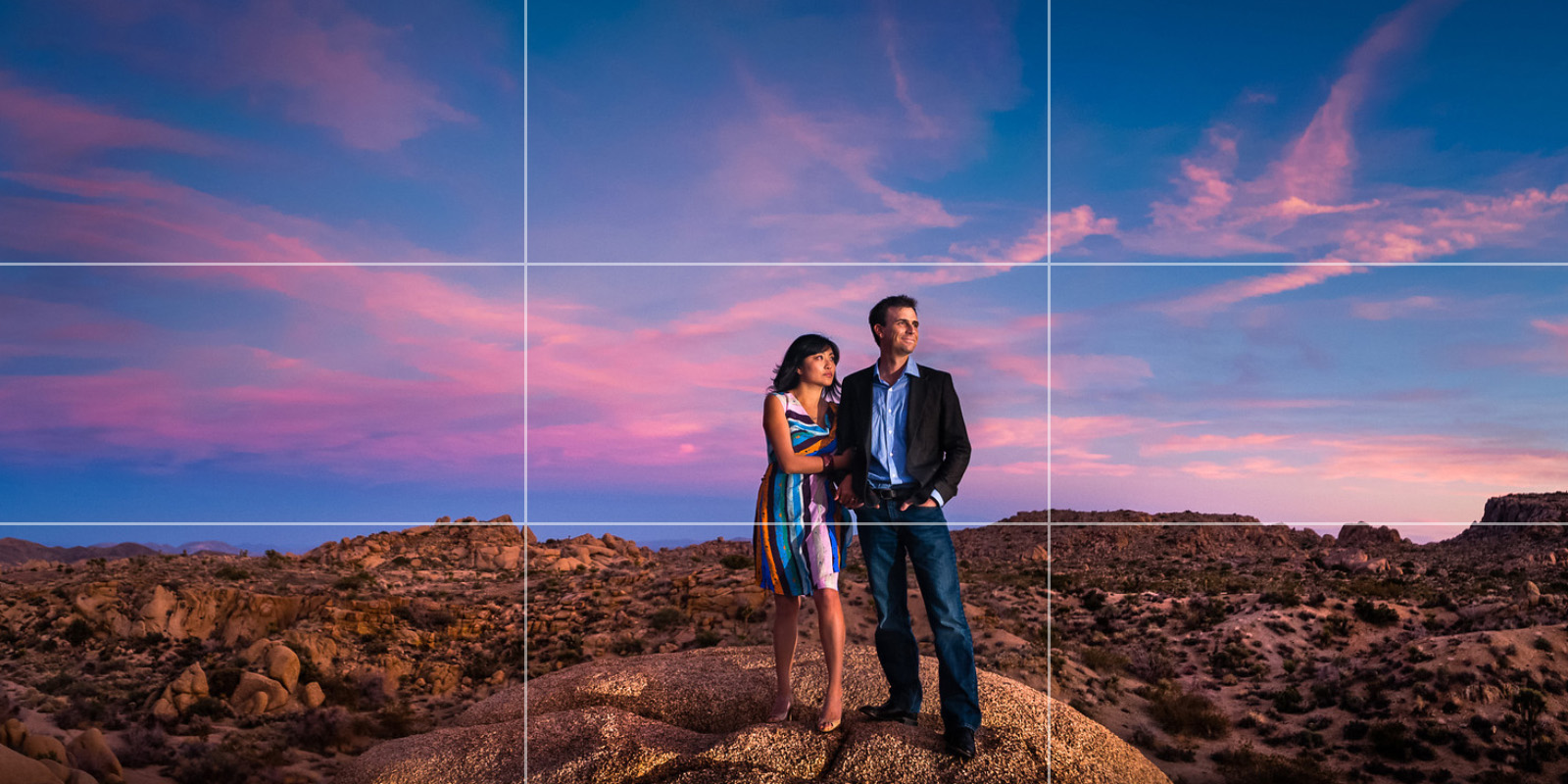
Some images use more than one point or line of the rule of thirds, while others will only apply a single line or point to their composition, and let other elements in the image fall wherever they may. (source : google)
6. DEPTH OF FIELD
Depth of field is the area of acceptable sharpness in front of and behind the subject which the lens is focused. Put simply, it refers to how blurry or sharp the area is around your subjectA shallow depth of field refers to a small area in focus. Often the subject is in focus, while the background is blurred. This is best for portraits, and one way to adjust this is with aperture.
A deep depth of field captures a larger area in focus, often keeping everything in the image sharp and clear. This is best for landscapes by using a large aperture.
There are multiple ways to adjust depth of field, including aperture, the distance between the camera and the subject, the focal length of the lens, and even the size of the camera’s sensor.
7. BALANCE
Balance in photography is observed when an image has subject areas that look balanced throughout the composition. It is achieved by shifting the frame and juxtaposing subjects within it so objects, tones, and colors are of equal visual weight. An image is balanced when subject areas command a viewer’s attention equally.
There are two main techniques of balance: formal and informal. However, there are also other kinds of formal and informal techniques that photographers have been practicing to balance out lightness and heaviness, varying shapes, and even meanings behind a composition.
Very good information 😊
ReplyDelete